
Most manufacturers I talk to are deep in 2027 planning right now. Capital requests are in and capacity targets are set. And somewhere, there's a slide with an automation roadmap and a go-live date on it.
What I rarely see included in that roadmap is a page on leadership. It becomes an assumption.
Most roadmaps assume that your plant manager can lead a crew through a new line, and your CFO can take out costs without breaking the organization. It assumes your VP of operations can stand up a second site while the first one keeps shipping. But what happens if those assumptions are wrong, and you don’t find out until the third quarter? By then, the project is late, and the person who should fix it is already covering two jobs.
The good news is that most manufacturers are feeling confident heading into 2027. In the NAM Q2 2026 Manufacturers' Outlook Survey, 74.2% said they felt positive about their company's outlook. But examine what lurks underneath underneath that confidence. Companies expect sales to grow about 3.3% over the next year while full-time headcount grows only about 1%, and they expect input costs to climb 5.8%.
How I read that: Leaders are expected to do more with roughly the same people, at a higher cost. Which means that every leadership hire you make in 2027 carries more weight than it did a year ago.
That's the thinking behind our manufacturing leadership 2027 outlook. We see six forces shaping the year. Each one asks something different of the people running your business, and each one should change how you plan your 2027 leadership hiring. Let's start with the one most plans already have a budget line for.
Force 1: AI and automation will test your plant leaders
Manufacturers have bought plenty of technology. Getting people to use it is the harder part. Parsec's 2026 State of the Manufacturing Industry report surveyed 1,200 manufacturing leaders and found that 72% have adopted AI in some form, but only 10% have deployed it at scale.
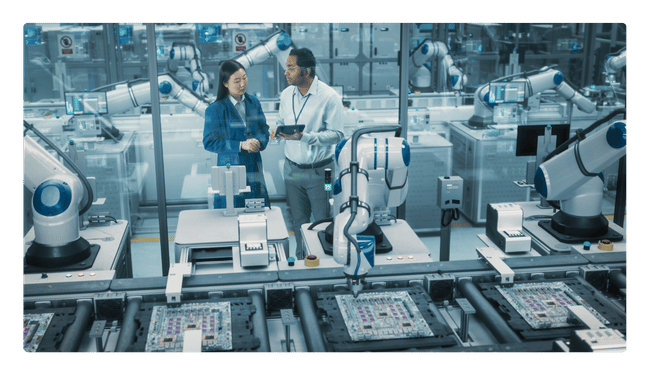
That gap usually comes down to people. A 2026 study from PwC and the Manufacturing Institute found that AI adoption can hinge on the attitudes and readiness of frontline leaders. In practice, if the shift supervisor doesn't trust the new system, the crew won't either. And a lot of supervisors haven't been given much to work with. In NAM's Q2 survey, about 41% of manufacturers said they provide no AI-related training to frontline workers at all.
So if automation is in your 2027 plan, your leadership bench needs:
-
Experience: Plant and operations leaders who've taken a workforce through a productivity dip during a rollout and come out ahead
-
Communication: Supervisors who can explain a change in plain terms and get buy-in on the floor
-
Organization: Engineering leaders who bring operations in from design through startup
Before you approve the project, ask who on your team has actually led a rollout like this, and what happened to output in the first 90 days. When a rollout stalls, look at the supervisor level before you call the vendor. That's where most of them break down, and it's the thread we follow in why manufacturing automation projects fail at the supervisor level.
Force 2: The skills gap lands on frontline supervisors
That supervisor layer is also where the workforce shortage hits hardest. Deloitte and the Manufacturing Institute project that U.S. manufacturing could need as many as 3.8 million additional workers between 2024 and 2033, and 1.9 million of those jobs could go unfilled. The Ohio Manufacturers' Association expects roughly 2.8 million of those openings to come from retirements.
Those figures usually get talked about as a hiring problem. On the floor, they turn into a supervision problem. The frontline supervisor trains new hires, covers the gaps and often decides whether a junior operator stays past 90 days. When a strong supervisor leaves, overtime climbs and turnover follows. Pretty soon the plant manager is running the shift.
Holding that layer together in 2027 takes:
-
Oversight: Operations leaders who track supervisor development like an operating metric
-
Incentive: Plant managers with a record of promoting from within
-
Guidance: HR leaders who can build internal career paths that people actually use
-
Emotional Intelligence: Supervisors hired for how they lead people as much as what they know about the process
Here's a simple test: if your best supervisor gave notice tomorrow, who would run that shift? Very few 2027 budgets have a line for that answer. It's why we think of the frontline supervisor gap as manufacturing's 2027 constraint that nobody budgeted for.
Force 3: A second round of margin pressure calls for different leaders
Even with the right people on every shift, the math for 2027 is getting tighter. Plenty of the manufacturers we work with have already taken one round of costs out. This round looks harder. In NAM's Q2 survey, 83.1% of manufacturers named rising raw material costs as a top challenge. Respondents expect input costs to rise 5.8% next year, while their own prices rise only 4.2%.
That 1.6-point gap has to come from somewhere. The easy savings went in the first round, so this time the cuts reach into the organization itself: shift structures, spans of control and which plants run what.
That's where lean manufacturing leadership earns its keep. A leader who's run lean as a daily operating system can find cost in flow, changeovers, and scrap before anyone starts talking about headcount. Food and beverage plants feel this hardest. Margins are thin and food safety can't slip, so food manufacturing leadership hiring tends to favor people who've cut costs without cutting corners. It also helps to have a finance leader who spends time on the floor and knows where the cost really sits.
Just keep in mind that the leader who takes costs out isn’t always the one who grows the business afterward. Before you open a search, decide which one the role needs. Get that answer right and you're most of the way to knowing how to take cost out of a manufacturing business without losing the organization.
Force 4: Supply chain volatility and new capacity need builders
Costs aren't the only thing moving. Trade uncertainty topped NAM's list of manufacturer concerns for five straight quarters. In Q1, more than half of manufacturers said they rely on Canada or Mexico for critical parts. When a supplier lane changes overnight, someone on your team has to make the call with half the information.
Meanwhile, capacity keeps coming back onshore. The Reshoring Initiative counted 244,000 U.S. manufacturing jobs announced through reshoring and foreign direct investment in 2024 alone.
That leaves a lot of leadership teams doing two very different jobs at once: re-sourcing and rerouting under pressure or standing up a new site. But building a plant and running a plant take different skills, and plenty of capable plant managers have only done one.
If either job is on your 2027 plan, you'll want:
-
Acumen: Supply chain and procurement leaders who can qualify new suppliers quickly and make calls on partial data
-
Vision: General managers and plant leaders with startup experience, including hiring a full team and commissioning lines from scratch
-
Administration: Operations executives who can run an expansion without starving the existing sites
Ask whether the person has built something from nothing or kept something running, and which one the role actually needs. Putting a strong run-rate plant manager in charge of a new site is one of the most expensive mistakes we see, which is why it pays to understand what actually changes when you're hiring for a plant startup vs. an established site.
Force 5: Private equity ownership changes what leaders are hired to do
A lot of that new capacity and the cost-out work is being driven by new owners. PE accounted for 44.3% of industrial M&A deals in Q2 2026, according to Houlihan Capital's analysis of PitchBook data, even as overall deal volume fell from Q1. Sponsors are buying plants to run them better, and that puts leadership right in the middle of the investment thesis.
After a deal closes, leaders face a new board, a 100-day plan, and monthly reporting they may never have dealt with before. In a roll-up, a plant manager may suddenly need to influence three sites they don't control.
The leaders who do well under new ownership have usually done it before. They know the reporting cadence, they can build numbers a board will read every month, and they can get results across sites they don't directly manage. They can also steady a team that's nervous about new owners. If you're not sure whether a leader fits, ask whether they've ever worked under a board that reads the numbers every month. The answer tells you a lot.
The first board meeting usually shows whether a team fits the thesis. The months that follow show how a private equity acquisition impacts a leadership team.
Force 6: Succession planning becomes a 2027 hiring decision
Every force so far assumes the leaders you have today will still be there in 2027. For a lot of companies, that's not a safe bet. In a 2025 survey by the Northeast Wisconsin Manufacturing Alliance, 75% of manufacturers said they were concerned about their workforce retiring. Only 37% had a plan to address it. Granted, that's just one region, but it matches what we've heard from clients nationwide.
From what we've observed, most succession plans name a successor for today's job. The harder question is whether that person is ready for the job as it'll look in 2027 – with new automation, a tighter cost structure and maybe a new owner. A great second-shift manager may be ready now for the plant you have. That doesn't mean they're ready for the plant you're building.
A plan that survives these stress tests names a successor and backup for every business-critical role, tests both against the 2027 strategy, and benchmarks them against outside candidates without assuming the answer is internal. Try it on your most important seat: if your plant manager retired in June, would the successor be ready for the plant you'll be running in 2027? That gap between ready now and ready for what's to come is where most manufacturing succession planning falls short.
Different 2027 challenges need different leaders
Put the six forces side-by-side and you’ll start to see a pattern around the type of leader needed for each. Different challenges call for different strengths; the same person can be a great fit in one situation, and a poor one in the next.
Most leadership teams we talk to are facing two or three of these at once. The real question for your 2027 hiring plan is whether the people in your seats match the forces you'll actually face.
How to build leadership hiring into your 2027 plan
Remember that missing page on leadership? This is where you write it. Before the budget locks, get honest answers to a few questions:
- Which two of these forces will hit our operation hardest in 2027?
- Who owns each one, and have they done it before?
- Where does our plan assume a leader we don't have yet?
- Which hires need to land in Q1 for the rest of the year to work?
The answers tell you which leadership hires belong in your 2027 plan and which ones need to start in Q1. Our Leadership Alignment Checklist walks through the business need, the leadership profile, the team around the role and market reality before a search starts. And if you're already weighing finalists, the Leadership Style Assessment shows how a candidate tends to lead and where they're likely to fit best.
We'll go deeper on each force over the coming weeks. The Full Cycle, our email newsletter, is the easiest way to follow the series, along with the manufacturing leadership news and search trends we're seeing.
Where Index Search fits
Every force in this outlook ends in the same place: a leadership seat that has to be right in 2027. The people who can fill those seats are rarely on the market. They're mid-rollout, mid-integration or running a plant that can't spare them. A job posting won't reach them, and a generalist recruiter won't know which of them has actually done the work.
That's the work we do every day. Index Search runs executive and professional searches only in manufacturing, distribution and industrial technology. So when a client needs a plant leader who's opened a greenfield site, or a CFO who's been through a sponsor's 100-day plan, we're not starting from scratch. We already know who's done that work, and we call them directly.
Every search starts with questions designed to align on what really matters: what does the business need now, and what does it need in the future? And how does this person fit into those goals. That answer shapes who we call, how we assess them, and how we present them to you. It's why our searches tend to take fewer interview cycles and land leaders who contribute sooner. That's how we approach manufacturing leadership recruiting, from manufacturing operations leadership to engineering, finance, sales and supply chain, and from individual contributors through the C-suite.
Timing matters too. Many senior leaders plan a move around year-end bonuses, so the leadership hires that land in Q1 usually start as searches in Q4. If your 2027 plan depends on a leader you don't have yet, now is the window.
Is there a 2027 leadership seat you're already worried about? It's worth a conversation.
Frequently asked questions
What will manufacturing leadership look like in 2027?
Manufacturing leadership in 2027 will be shaped by six forces: AI and automation reaching the floor, a shortage of skilled workers and frontline supervisors, ongoing cost and margin pressure, supply chain volatility and new U.S. capacity, private equity ownership and integration, and retirement-driven succession. Leaders will be asked to deliver growth with roughly flat headcount and rising input costs.
What are the biggest challenges for leadership in manufacturing heading into 2027?
Rising input costs and trade uncertainty top manufacturers' concerns. NAM's Q2 2026 survey found 83.1% cited raw material costs and 71.8% cited trade uncertainty. On the people side, the hardest problems are getting new technology adopted, keeping frontline supervisors, and preparing successors as experienced leaders retire.
How should manufacturers prepare their leadership teams for 2027?
Start with the plan. Identify which forces will hit your operation hardest, then check whether your current leaders have handled those situations before. Name a successor and a backup for each critical role, and decide which hires need to land in Q1 for the year to work.
When should a manufacturer use manufacturing leadership recruiters?
Manufacturing leadership recruitment through a specialized search firm makes sense when the role is business-critical and the right candidates probably aren't job hunting. It also helps when the role calls for experience your network can't reach, like a plant startup, a PE integration or a lean manufacturing leadership search. Manufacturing leadership recruiters who focus on industrial roles can reach passive candidates and judge operational fit faster than a generalist firm.
Where can I find manufacturing leadership jobs?
Index Search posts current manufacturing leadership jobs in operations, engineering, supply chain, finance and more on our open roles page. Many of our searches are never posted publicly, so it's worth sharing your background with our team directly.